
Flintstone, Georgia (Chattanooga Valley)

Updated: Apr 20

Introduction
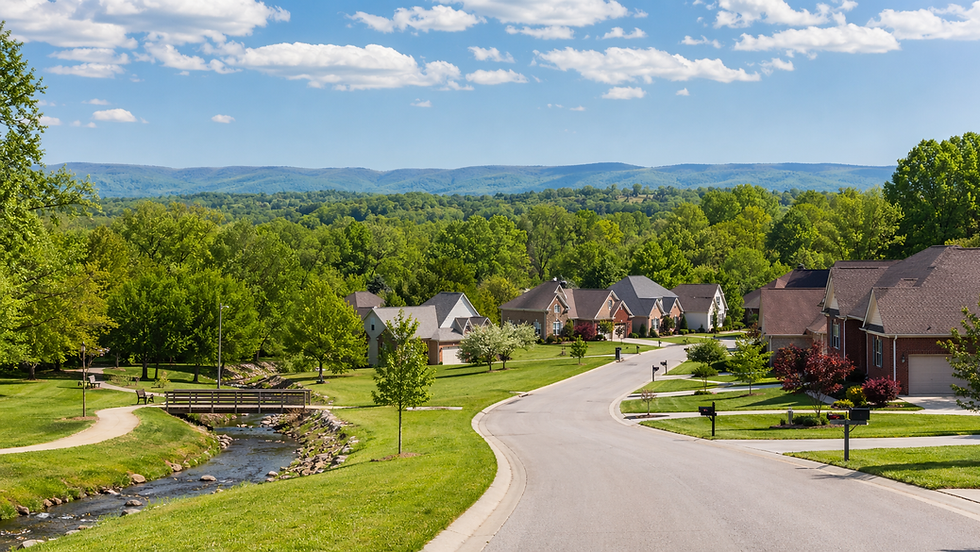
Flintstone, Georgia offers a quieter, more spacious way to live while still keeping Chattanooga within reach. It is an unincorporated community in Walker County, but daily life is shaped by the wider Chattanooga Valley, the foot of Lookout Mountain, the Tennessee line, and nearby places like Fort Oglethorpe, Rossville, and Chattanooga. That is part of what gives the area its appeal. It feels more open and less pressured than places closer to the city, while still connecting easily to the larger Chattanooga area. The Chattanooga Valley census-designated place has 4,601 residents, while the broader Chattanooga Valley CCD has 10,662. For someone trying to understand what it would be like to live here, that broader valley geography is usually the more useful frame.
For many buyers, the appeal is straightforward: more space, more quiet, and often better value than neighborhoods closer to Chattanooga. Flintstone is not the kind of place people choose for a downtown district or a polished town-center feel. They choose it because it offers a steadier, lower-density setting with schools, county services, and everyday needs spread across the valley and nearby communities. A serious buyer usually wants to know how that tradeoff works in real life: how far daily needs are, what schools and services anchor the area, what kind of housing is typical, and how the community fits into the wider Chattanooga side of the region.
Who This Guide Is For
This guide is for buyers who are considering Flintstone and the surrounding Chattanooga Valley as a place to settle, not just a place to purchase property. It is especially useful for people comparing this area with Fort Oglethorpe, Chickamauga, Rossville, East Ridge, or other nearby communities and trying to understand the real tradeoffs rather than the marketing version. Flintstone tends to appeal to buyers who want detached housing, a more settled ownership market, and access to the Chattanooga area without living inside the city itself.
It is a weaker fit for someone who wants a walkable commercial district, a short errand loop, or a place whose identity is easy to sum up in one phrase. Chattanooga Valley’s homeownership rate is 71.1 percent, and the median owner-occupied home value is $205,300, which helps explain why it attracts buyers looking for continuity, room, and a more stable housing pattern. The tradeoff is that daily life is more spread out and less convenient in the urban sense. This is a place for people who do not mind driving, who value established routines, and who are comfortable living in a community whose shape is broader than its official name.
Community at a Glance
At a practical level, Flintstone sits inside a moderate-scale valley community that feels established rather than newly assembled. The Chattanooga Valley CDP includes about 1,620 households and 1,660 housing units. The broader CCD includes 4,047 households and 4,508 housing units. Those numbers help explain the area’s feel. There is enough scale to support schools, civic routines, and a recognizable local identity, but not so much that the place reads as a fast-moving suburban growth zone.
The more important fact is that the local identity overlaps. A person may live in Flintstone, attend Chattanooga Valley schools, go to high school in Rossville, shop in Fort Oglethorpe, work in Chattanooga, and still think of all of it as part of the same daily map. That is not confusion. It is the normal structure of the place. A useful guide to Flintstone has to keep that lived geography in view, because the official labels only tell part of the story.
How the Community Developed, and Why That Still Matters
The present-day character of Flintstone and Chattanooga Valley starts with land, not branding. Walker County was formed in 1833 from land that had belonged to the Cherokee, after dispossession and the 1832 land lottery opened the area to white settlement. That history matters because it explains why the community developed as a network of valley roads and dispersed settlement rather than as a single town built around one compact center. Flintstone did not begin as a modern suburb, and it still does not function like one.
Geography shaped what followed. Settlement favored the valleys and more workable ground rather than the thinner plateau soils. That pattern is still visible in the way homes, schools, utilities, and roads gather along the valley floor while Lookout Mountain remains both a boundary and a defining presence. Civil War history reinforced that geography. The nearby Chickamauga and Chattanooga campaign was fought over this landscape because the ridges, valleys, and access to Chattanooga mattered strategically. They still matter in calmer ways now. The mountain edge, the road network, and the broader regional orientation of the valley are all present-day expressions of that older geography.
What Holds the Community Together
Flintstone is not held together by city government in the usual way. It is held together by institutions people move through repeatedly over many years. The school system is the clearest example. Chattanooga Valley Elementary and Chattanooga Valley Middle are both in Flintstone, while Ridgeland High serves a broad group of nearby communities including Flintstone, Lookout Mountain, Fairview, Chickamauga, High Point, Kensington, McLemore’s Cove, and Rossville. That school pattern does more than sort students. It creates a shared civic frame across the valley.
The same is true of local organizations and county systems. The Chattanooga Valley Lions Club, still active decades after its 1971 charter, is part of the area’s civic backbone. Its annual Four-Wheel Parade remains a recognizable local tradition not because it is polished or widely marketed, but because it comes out of an older pattern of service-club life and community participation. County systems matter too. The Walker County Water & Sewerage Authority is based in Flintstone, and Walker Transit provides practical transportation for errands and appointments across the county. These are not glamorous facts, but they explain something important: the area is held together by durable routines and institutions, not by image.
Regional Position and Everyday Reach
One of Flintstone’s main strengths is its position between local quiet and regional access. Ridgeland High notes that it sits only 4.1 miles from Fort Oglethorpe and 2.5 miles from the Tennessee line. That helps explain why so much of daily life extends beyond Flintstone itself. The community is clearly part of Walker County, but it lives within the Chattanooga area’s economic and service reach.
In practical terms, that means many residents look to Fort Oglethorpe for regular shopping, to Chattanooga for larger employment and hospital care, and to the wider valley and mountain edge for recreation. Battlefield Parkway in Fort Oglethorpe functions as a routine errand corridor, not an occasional side trip. The same logic applies to healthcare. Many needs can be handled locally or nearby, but larger care networks pull people toward Chattanooga. At the same time, the valley is not fixed in place. Recent approval of a zoning change for Rock City’s proposed gondola project is a reminder that tourism, traffic, and land-use pressure at the foot of Lookout Mountain may continue to shape the area. Flintstone is not isolated; it sits on an active regional edge.
Schools and Family Practicality
For families, the schools are one of the clearest ways to understand how the community works. Chattanooga Valley Elementary serves 418 students in pre-K through fifth grade. Chattanooga Valley Middle serves 449 students in grades six through eight. Ridgeland High serves 1,284 students in grades nine through twelve. These are substantial enough enrollments to support real school culture, but still tied closely enough to the surrounding communities that schools remain one of the main ways people understand the area.
Ridgeland’s graduation rate adds important context. The school reports that it rose from 59 percent in 2007 to 91.7 percent in 2023. That is a useful measure because it shows institutional direction over time rather than offering only a snapshot. For buyers with children, the larger point is that school life here is central to the rhythm of the place. Drop-off and pickup patterns, after-school schedules, sports calendars, and family networks all run through the Chattanooga Valley to Ridgeland system. Buyers should pay attention to exact school assignments, but they should also understand that schools here do more than educate. They help organize the valley socially.
Housing: What Buyers Are Actually Choosing
The housing market in Flintstone and the surrounding valley is best understood as ownership-heavy, moderately priced by regional standards, and relatively settled. Median owner-occupied home value is $205,300 in Chattanooga Valley and $197,100 in Walker County. The county’s median gross rent is $940, which is useful mainly as a broad benchmark rather than the main story. The more important fact is that 71.1 percent of occupied housing in Chattanooga Valley is owner-occupied. This is a place where buying is still the dominant pattern.
That shapes what buyers are actually choosing. In most cases, they are not comparing a wide range of housing formats or deciding between distinct urban lifestyles. They are deciding whether this kind of low-density, road-oriented, detached-house market fits the life they want. The appeal is clear: more space, a more established feel, and a housing market that often feels steadier than some faster-moving parts of the Chattanooga area. The tradeoff is just as clear: less variety, fewer truly close-in conveniences, and a stronger dependence on driving for ordinary life.
The area also appears relatively stable. Only 4.4 percent of Chattanooga Valley CDP residents and 5.5 percent of the broader CCD population moved in the previous year, while Walker County recorded 344 building permits in 2024. That combination suggests modest ongoing growth inside a market that still turns over slowly. For buyers, that often means less churn and less speculative energy, but it can also mean waiting longer for the right property or the right location within the valley.
What Everyday Life Looks Like in Practice
Day-to-day life in Flintstone is built around movement between places rather than life within one compact district. Chattanooga Valley’s average commute is 27.5 minutes, and 86.1 percent of workers drive alone. That tells you a great deal. People here generally move by route: from the house to school, from school to work, from work to errands, and back again across the valley or toward the state line. A buyer who expects everything to happen nearby may find the area inconvenient. A buyer who is comfortable with driving and wants a quieter home base may find the pattern entirely reasonable.
In practice, that often means regular shopping on Battlefield Parkway, school events that pull families across the valley, healthcare trips toward Chattanooga, and weekends shaped by the mountain and nearby parkland. Lula Lake Land Trust, an 8,000-acre watershed on Lookout Mountain, is a good example of how recreation fits into local life. It is close enough to matter, but access is organized through reservation-only Open Gate Days on the first and last weekends of each month. That detail is revealing. Outdoor life here is real and valued, but it often depends on routine, planning, and familiarity with the area rather than pure spontaneity.
Civic Events, Sports, and Activities New Residents Should Know
The events that matter most in Flintstone and Chattanooga Valley are the ones that show how local life actually works. The Chattanooga Valley Lions Club Four-Wheel Parade is one of those events. It has been around long enough to feel established, it supports Stocking Full of Love, and it reflects a civic culture rooted in service rather than spectacle. A new resident who pays attention to that event will understand more about the community than they would from a long list of public happenings.
School sports matter for similar reasons. Ridgeland’s athletics calendar carries weight because the high school serves such a wide valley area. Games, tournaments, and school events become shared points of contact for families spread across a broad geography. Over time, these are the rhythms many residents come to know: the Four-Wheel Parade in December, Panther sports through the school year, Lula Lake Open Gate Days when the weather is right, and regular use of the national military park as both a historical landmark and a familiar place to spend time. These are not just activities near Flintstone. They are part of how the area maintains a sense of itself.
Where People Work, and Why the Job Base Matters
Flintstone does not sit inside a purely residential landscape. Walker County reports a labor force of 33,476, with nearly 43 percent of local jobs in services and 34 percent of private employment in manufacturing. Major employers include Roper Corporation, Shaw Industries, Hitachi Astemo, Labrie Enviroquip, and Five Star Breaktime Solutions. That matters because it means the local economy is not just an appendage of Chattanooga. Walker County still provides a substantial employment base of its own.
At the same time, Chattanooga remains an important part of the picture. The Chattanooga Chamber’s 2026 major-employer list includes BlueCross BlueShield of Tennessee, Erlanger Health, Hamilton County Schools, and Volkswagen Chattanooga, all large enough to shape commuting patterns well beyond the city limits. Walker County is also still attracting major investment. Pilgrim’s announced a $400 million prepared foods facility in 2025 expected to create more than 630 jobs, while Roper had already announced a $118 million expansion creating 600 jobs. For a buyer, the key point is that Flintstone sits between a county-level industrial and service economy and a larger metro labor market. That gives the place more economic depth than a simple bedroom-community label would suggest.
Why People Stay
People stay in Flintstone and the surrounding Chattanooga Valley for a set of reasons that work together. Housing remains comparatively moderate. Ownership is common. Turnover is low enough to suggest that once households settle here, many remain. The schools are central to daily life. The mountain edge and battlefield landscape are close enough to become part of ordinary experience rather than occasional outings. Taken together, those factors create a place that feels established rather than provisional.
Just as important, Flintstone still feels like a community formed over time rather than assembled all at once. It does not depend on polished branding to make sense. It depends on schools, county systems, long roads, local traditions, and a broader valley identity that residents understand even when outsiders do not. That makes it a poor fit for buyers who want instant convenience or a ready-made town-center lifestyle. It makes it a strong fit for buyers who want steadier ground, more room, and a community whose logic becomes clearer the longer they live in it.
References
Census Reporter and U.S. Census Bureau materials for Chattanooga Valley CDP, Chattanooga Valley CCD, and Walker County, Georgia — used for population, households, housing units, owner-occupancy, rent, home values, income, commute, mobility, and building-permit data.
Data USA profile for Chattanooga Valley, Georgia — used for homeownership, commute patterns, drive-alone share, work-from-home share, and household vehicle data.
Walker County, Georgia official pages — used for county history, business and economic development, Walker Transit, recreation context, and the zoning-change discussion tied to the proposed Rock City gondola project.
New Georgia Encyclopedia entries on Walker County and the Appalachian Plateau — used for Indigenous history, Cherokee removal context, settlement patterns, and landscape background.
National Park Service materials for Chickamauga & Chattanooga National Military Park — used for Civil War context and the historical significance of the surrounding landscape.
Walker County Schools / Ridgeland High / NCES school profiles — used for school geography, enrollment, and graduation-rate context.
Chattanooga Valley Lions Club materials — used for club history, charter date, and the Four-Wheel Parade tradition.
Chattanooga Area Chamber of Commerce major-employers materials — used for Chattanooga-area employer scale and commuting context.
Lula Lake Land Trust / Walker County recreation materials — used for preserve size, access patterns, and Open Gate day context.
Walker County Water & Sewerage Authority materials — used for local utility and civic-infrastructure context.
Battlefield Parkway retail-corridor and Food City references, along with Erlanger East Hospital materials — used for the discussion of everyday shopping and healthcare patterns beyond Flintstone’s formal boundaries.


Comments