
Dalton, Georgia: A Grounded North Georgia City With Work, Roots, and Room to Belong


A Look at Dalton
Dalton, is one of the main working cities of northwest Georgia. It is the county seat of Whitfield County, a long-established manufacturing center, a regional health care and education hub, and a practical home base for people who want access to both Chattanooga and North Georgia without living in a larger metro.
Dalton sits along I-75 about 30 miles south of Chattanooga and roughly 80 to 90 miles north of Atlanta, depending on the route. That location matters, but Dalton is more than a place between bigger cities. Many residents work locally, send children to local schools, use local parks, visit Hamilton Medical Center, attend Dalton State College, shop along Walnut Avenue, and build regular weekly routines without leaving town.
That is one of the main things buyers should understand. Dalton is not just a commuter town. It has its own job base, its own school systems, its own hospital, its own downtown, and its own rhythm. The average commute time is about 17.5 minutes, which helps explain why the city feels more self-contained than many smaller towns nearby.
Dalton is still closely tied to flooring manufacturing. Its identity as the “Carpet Capital of the World” is real, and the flooring industry continues to shape the local economy, workforce, roads, and land use. But Dalton is not only a carpet town. It is also a majority-Hispanic city, a youth-sports community, a college town, and a place where older neighborhoods, suburban edges, and newer growth all sit close together.
For buyers, Dalton’s appeal is practical. It offers local employment, more attainable housing than many larger markets, easy road access, medical care, schools, parks, sports, and a downtown center. The question is not whether Dalton is simply “good” or “bad.” It is whether Dalton’s mix of attainability and local character fits the life you are trying to build.
Who Dalton Fits Best
Dalton can be a strong fit for buyers who want a real North Georgia city with plenty of options for jobs, housing, and regular community events. It may also work well for households connected to manufacturing, logistics, health care, education, trades, small business, or who need to commute to larger cities.
It may be less ideal for buyers who want a newer suburb, a quieter residential town with little industrial activity, or a place where every neighborhood feels similar. Dalton's variety is one of its strengths. In Dalton, a few blocks matter more than they seem. So can city limits, school zones, proximity to I-75, distance from industry, access to Walnut Avenue, and the routes between daily destinations.
Dalton had an estimated population of about 35,000 in 2024. That gives it enough scale to support major employers, a college, city and county services, and downtown events. It is not a large metro, but it is large enough to function as a daily-life center for much of Whitfield County.
Housing numbers also help explain why Dalton gets attention from buyers. The median value of owner-occupied homes was about $222,400, and median gross rent was about $996 in recent Census data. Those numbers do not mean every home is inexpensive or every buyer will find an easy deal. Condition, location, interest rates, insurance, taxes, and repairs still matter. But compared with many larger markets, Dalton can offer a more realistic entry point for buyers.
Dalton also looks different from many other North Georgia towns because of its population makeup. For many residents, that mix of population is one of Dalton’s strengths. It gives the city a broader cultural and economic life than some nearby communities.
How Dalton Became What It Is
Dalton’s present makes more sense when you know how the city developed. Before it became a railroad town, a county seat, or a flooring center, northwest Georgia was Cherokee land. New Georgia Encyclopedia does say the Trail of Tears “began in present-day Dalton,” and the City of Dalton says the final council meeting in Whitfield County marked the starting point of the Trail of Tears. But Visit Dalton also says it began “just north of Dalton in Red Clay, Tennessee.”
In 1837, a settlement called Cross Plains developed as a trade-junction village. People and goods moved through this part of northwest Georgia. Railroad access later changed the town’s future. The Western and Atlantic Railroad connected the area to Atlanta and Chattanooga, and another rail connection helped make Dalton a transfer point. Whitfield County was formed in 1851, and Dalton became the county seat.
That early pattern still matters. Dalton grew because it sat where movement, trade, government, and later industry could meet. Today, that same pattern shows up in I-75 access, freight movement, manufacturing corridors, county services, retail traffic, and regional employment.
The Civil War also left a mark on the area. After the fighting around Chattanooga, Confederate forces used the Dalton area as part of the defensive line before Sherman’s Atlanta Campaign moved south. Places such as Tunnel Hill, Dug Gap, and Rocky Face Ridge still connect the city to that history through markers, road names, and nearby historic sites.
After the war, Dalton moved more deeply into manufacturing. Textile work became central to the city’s economy. Dalton’s later flooring story grew from hand-tufted bedspreads and chenille production. Catherine Evans Whitener’s hand-tufting work helped create a cottage industry that eventually developed into machine-tufted carpet manufacturing after World War II.
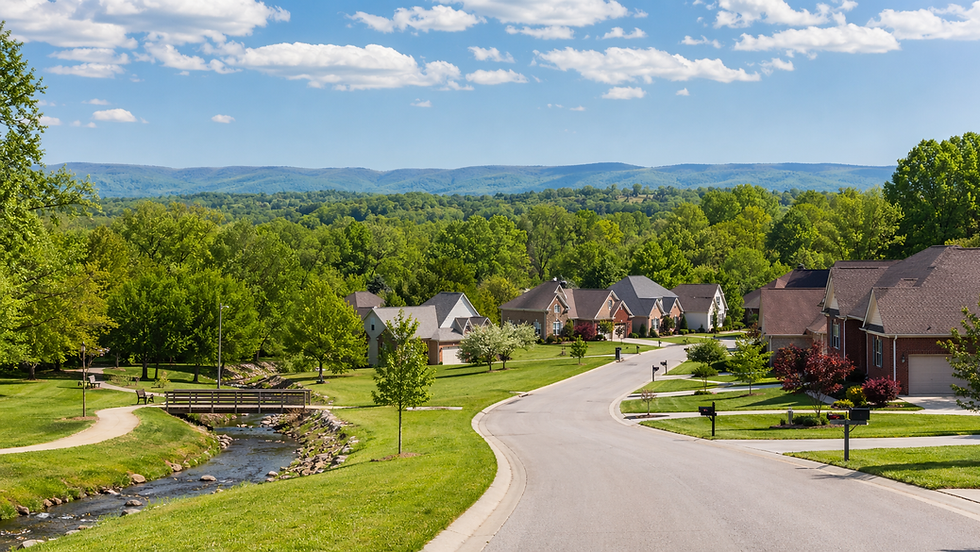
Dalton’s housing did not develop all at once. It came in layers. There are older homes near the city core, mid-century neighborhoods, brick ranch houses, commercial corridors, and newer construction further out. The road network, job base, and housing patterns all reflect Dalton’s path from trade stop, to railroad town and to a local, manufacturing city.
The Local Backbone: Jobs, Schools, Hospital, Parks, and Downtown
Dalton works because several practical pieces support daily life at the same time. The city has employers, schools, parks, downtown activity, churches and youth sports. None of these pieces tell the whole story by itself. Together, they explain why Dalton functions as the community's real local center.
Downtown Dalton gives the community more than a place to run errands. It gives residents a recognizable center for restaurants, small businesses, public events, concerts, professional offices, and places to gather. Burr Performing Arts Park, the farmers market, downtown restaurants, and seasonal events give residents reasons to use downtown in everyday life.
Parks and recreation are another major part of Dalton’s structure. Dalton Parks and Recreation maintains more than 1,400 acres, 16 parks, athletic fields, tennis courts, playgrounds, recreation centers, a senior center, and Nob North Golf Course. Those facilities matter because they support normal routines: youth sports, walking, golf, senior programs, playground time, practices, tournaments, and weekend recreation.
Hamilton Medical Center also helps Dalton stand on its own. A 255-bed regional hospital gives residents local access to major medical services without making every health-care need a Chattanooga or Atlanta trip. For buyers with children, aging parents, health concerns, or health-care jobs, this can be a major pull factor.
Dalton State College adds another layer. It brings higher education, workforce training, students, faculty, and community programs into the city. With more than 5,500 students reported in fall 2025, Dalton State is part of how the city prepares workers, keeps young adults connected to the area, and supports local opportunity.
City Limits, School Lines, and the Wider Dalton Area
Dalton’s lived geography is wider than the city boundary, but the boundary still matters. Many homes with a Dalton mailing address are not inside Dalton city limits. That can affect schools, taxes, utilities, trash service, zoning, and commute routes.
This is especially important for schools. A Dalton address does not automatically mean Dalton Public Schools. Dalton Public Schools generally serves families inside the city limits. Whitfield County Schools serves much of the surrounding county area, including many homes with Dalton mailing addresses.
Dalton Public Schools is the city school system. NCES data for the 2024–2025 school year listed 10 schools and about 7,600 students. Dalton High School reported a 91.4% graduation rate in 2025, above Georgia’s statewide graduation rate of 87.2%.
Whitfield County Schools serves the broader county, including communities tied closely to Dalton such as Cohutta, Tunnel Hill, and Varnell. For families, this means school research has to happen property by property.
This also matters for resale. Even buyers without school-age children should pay attention because school zones often shape buyer demand, neighborhood patterns, and long-term value.
Regional access matters too. I-75 gives Dalton a strong north-south connection. Residents can drive north toward Ringgold, Fort Oglethorpe, East Ridge, and Chattanooga, or south toward Calhoun, Cartersville, Marietta, and Atlanta. Chattanooga adds airport access, larger entertainment options, additional employers, specialty medical services, and broader shopping.
Walnut Avenue is one of Dalton’s main everyday roads. It connects I-75 traffic with restaurants, hotels, shopping, and local errands. Thornton Avenue, Cleveland Highway, Dug Gap Road, and other main roads also shape how the city feels during the week. A home can look close to everything on a map and still feel inconvenient if the daily route crosses heavy traffic or does not match the buyer’s work and school schedule.
What Dalton Buyers Will Actually Find
Older in-town homes can be attractive for buyers who want mature trees, established streets, larger porches, and proximity to downtown or local services. Some have real character and a stronger sense of place than newer subdivisions. The tradeoff is condition. Older roofs, HVAC systems, electrical service, plumbing, windows, crawlspaces, moisture control, and layout issues can all affect cost after closing.
Mid-century and later suburban homes often offer modern layouts, carports or garages, usable yards, and easier day-to-day living. These homes may sit near schools, churches, parks, or work routes. Buyers still need to study the surroundings. A home near a busy road, industrial edge, or commercial area may feel different during shift changes, school traffic, or weekend retail traffic.
Newer homes around the edges of Dalton and Whitfield County may offer modern floor plans, attached garages, newer systems, open kitchens, and more consistent neighborhood design. The tradeoff may be distance from downtown, less mature landscaping, a different school district than expected, or a commute pattern that depends heavily on one route.
Industrial adjacency is one of Dalton’s most important buyer realities. The same employers that support local jobs also create truck traffic, rail activity and busier roads. Some buyers will be comfortable near that activity because it shortens a work commute or lowers the purchase price. Others will want more distance from industrial land uses.
Neither choice is automatically wrong. The key is to be intentional. Visit homes at different times of day. Notice traffic, noise, nearby businesses, truck routes, and how the area feels during school pickup, shift changes, and weekends. Dalton rewards careful property-by-property evaluation.
Life as a Dalton Resident
For many households, Dalton’s appeal is not about one big lifestyle feature. It is about having the pieces of life close enough to work together. A parent may be able to get from school to work to a soccer field without crossing a major metro. A hospital worker may live near Hamilton Medical Center. A manufacturing employee may choose a home based on shift times and access to I-75 or a specific plant. A retiree may value local medical care, familiar roads, parks, and nearby family.
Outdoor routines are also part of the city. Haig Mill Lake Park, Lakeshore Park, Brookwood Park, Heritage Point, Riverbend Park, Raisin Woods Mountain Bike Park, and other facilities give residents options for walking, fishing, youth sports, biking, golf, playground time, and casual time outside. These places matter because they support repeat habits, not just occasional outings.
Dalton’s bilingual and immigrant character is also part of everyday life. Spanish and English are both visible in schools, businesses, restaurants, churches, and workplaces. For buyers moving from less diverse towns, this may be one of the first things they notice. For many residents, it is part of what makes Dalton feel connected to more than one culture.
Markets, Music, Soccer, and the Local Routines
Dalton’s events and sports matter because they show where residents gather and what local routines look like. The strongest examples are not just attractions. They are repeat activities people build into the year.
The Downtown Dalton Farmers Market gives residents a regular reason to come downtown. Held at Dalton Green on Tuesdays and Saturdays during the season, it connects local vendors, shoppers, and families in a simple, repeatable way. For someone new to Dalton, it is one of the easiest ways to see the city’s civic life without needing an invitation.
Off the Rails is one of Dalton’s major summer traditions. The concert series is held outdoors at Burr Performing Arts Park in downtown Dalton and runs on Friday nights during the summer season. Its value is not only the music. It brings people downtown on a regular schedule and gives residents a shared summer rhythm.
Burr Performing Arts Park is important for the same reason. A downtown needs usable public space, not just storefronts. Burr Park gives Dalton a place for concerts, food trucks, vendors, and civic gatherings. It helps downtown stay active beyond normal business hours.
Sports may be even more central to Dalton’s local identity. Soccer has a strong place in the city, from youth recreation to high school and college programs. Dalton is often associated with the “SoccerTown USA” identity, and that reputation comes from real participation and success over time.
The broader sports infrastructure is also significant. Dalton has large baseball, softball, soccer, football, basketball, volleyball, and tournament facilities. Places such as Riverbend Athletic Park, Heritage Point Regional Park, Edwards Park, Dalton Soccer Stadium, Westside Park, and the Dalton Convention Center support practices, games, tournaments, weekend travel teams, and local recreation.
The Work Base That Shapes the City
Dalton’s job base is one of the main reasons it functions as a true regional center. Many North Georgia towns depend heavily on nearby metros for employment. Dalton has a large local employment base of its own.
Flooring still leads Dalton's economic story. Major manufacturing employers in Dalton-Whitfield include Shaw Industries, Mohawk Industries, Engineered Floors, Qcells, and Tarkett. Shaw and Mohawk each employ thousands in the area, and Engineered Floors is also a major local employer. Those numbers explain why manufacturing remains central to Dalton’s economy.
But Dalton’s employment base is not limited to flooring. Major non-manufacturing employers include Whitfield County Schools, Hamilton Medical Center, Dalton Public Schools, Whitfield County government, the City of Dalton, Walmart, Dalton Utilities, the North Georgia Health District, Windstream, and Highland Rivers Center. That mix gives the city jobs in education, health care, government, utilities, retail, mental health services, and communications.
Qcells is worth noting because it shows Dalton’s manufacturing economy is not only tied to older industries. Solar-related advanced manufacturing has added another layer to the local job base. Dalton’s workforce, industrial land, transportation access, and manufacturing knowledge make it attractive for more than carpet production alone.
Dalton’s economy is a strength, but it should be understood honestly. A working city has movement, noise and shift changes. Those are not flaws by themselves. They are part of how Dalton functions. The key is choosing a home where those patterns match your routine.
Why Dalton Keeps People
People stay in Dalton because the city is useful, established, and connected. It has local jobs, public schools, county services, health care, college access, parks, youth sports, downtown events, churches, restaurants, and direct interstate access. That combination gives residents a full daily-life base without requiring constant trips to Chattanooga or Atlanta.
Families may stay because children become rooted in schools, teams, churches, and friend groups. Workers may stay because good employment is close to home. Retirees may stay because medical care, familiar roads, parks, and family support are nearby. Business owners may stay because Dalton has enough population, industry, and regional traffic to support local commerce.
Dalton also has continuity. Its history is visible in downtown, older residential streets, mill-era areas, Civil War sites, and the flooring industry. At the same time, the city has changed through immigration, new industries, changing school needs, and redevelopment efforts. That mix of old and new gives Dalton more depth than a simple “carpet town” label allows.
Dalton’s strongest case is practical and positive. It offers housing options, local employment, medical care, recreation, schools, sports, and regional access in one place. It gives buyers a chance to live in a North Georgia city with roots and real daily function.
For buyers who want a grounded North Georgia city with jobs, services, parks, schools, sports, history, and enough infrastructure to support daily life, Dalton is worth a look.
Thinking About Moving to Dalton?
Hi, I’m Lilly Garrett, assisting my dad, Daniel Garrett, with Mighty Oaks Realty. I’m so glad you took the time to read this guide. If you’re thinking about moving to Dalton or one of the nearby North Georgia communities, we’d love to help you learn the area, compare your options, and find a place that fits this next season of life.


Comments